Sustainable autonomy
Designing robots that run on renewable power and use energy efficiently, so they can work in the field for an entire growing season without interruption.
Oregon State University · MIME
The Sustainable Field Robotics Lab develops intelligent, energy-aware robotic systems for agriculture and other demanding outdoor environments. We combine machine vision, robotic manipulation, artificial intelligence, and renewable-energy-aware design to reduce the energy, labor, and environmental cost of field operations.
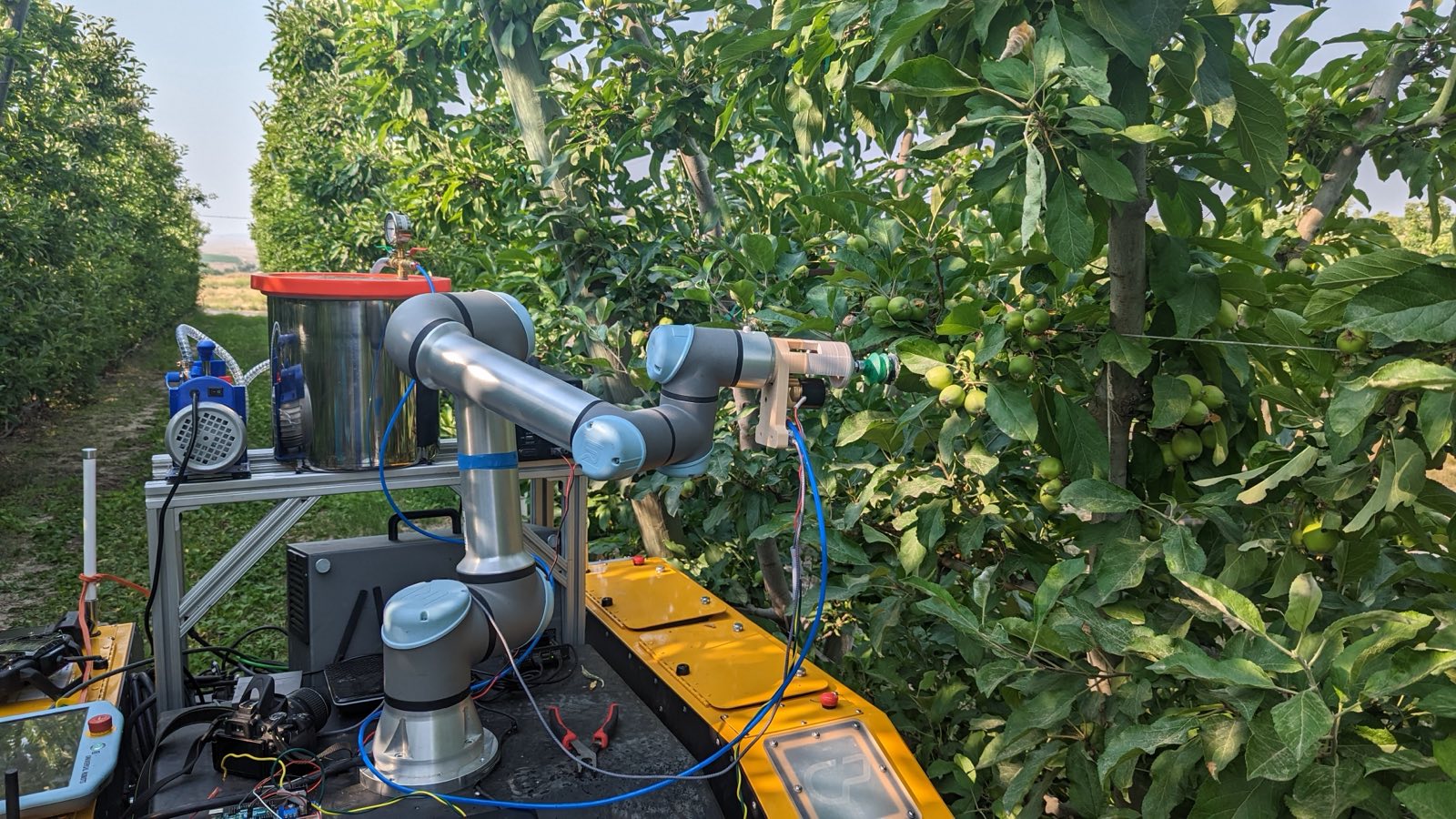
Agriculture first. Field robotics broader. Energy-aware everywhere.
Designing robots that run on renewable power and use energy efficiently, so they can work in the field for an entire growing season without interruption.
Teaching machines to see and reason in outdoor environments where lighting, occlusion, and weather change constantly, using camera, depth, and LiDAR data alongside modern vision-language models.
Building end effectors and motion plans that can handle fruit, flowers, shoots, and branches without bruising or breaking them.
Testing and hardening systems so they work reliably across orchards, vineyards, greenhouses, forests, and other demanding outdoor conditions.
Our primary focus is specialty crops, including fruit, vegetables, and nursery stock, where much of the work is still done by hand. We develop robotic systems for picking and harvesting, weeding, pruning, green-fruit thinning, pollination, and crop monitoring and yield estimation.
Our systems are tested and deployed in orchards, vineyards, greenhouses, forests, wildfire-affected terrain, and row-crop fields. These environments demand robust, field-ready engineering that can handle uneven ground, variable lighting, and unpredictable weather.
Active
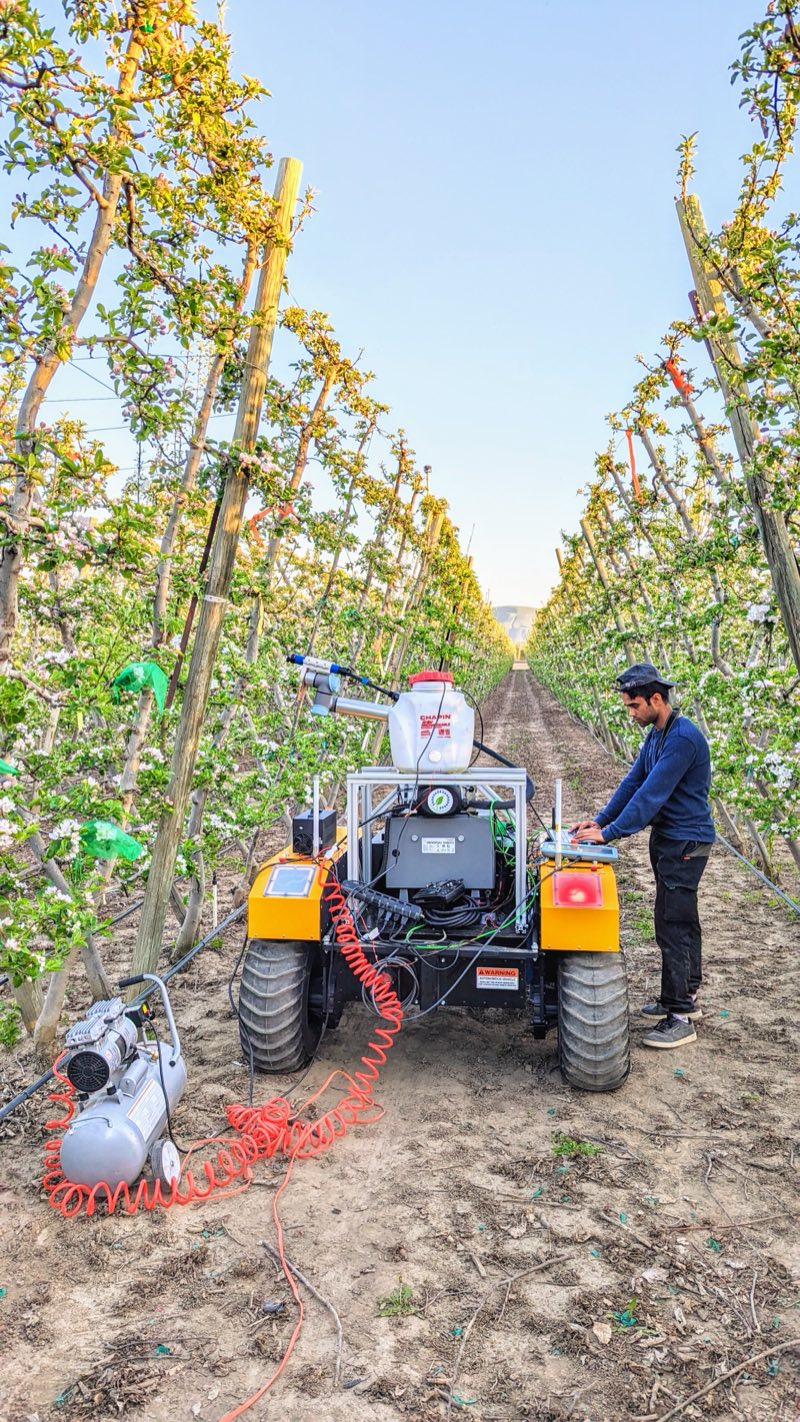
A vision-guided robot that finds king flowers in apple canopies and delivers pollen precisely, reducing dependence on managed bees during unreliable bloom weather.
Active
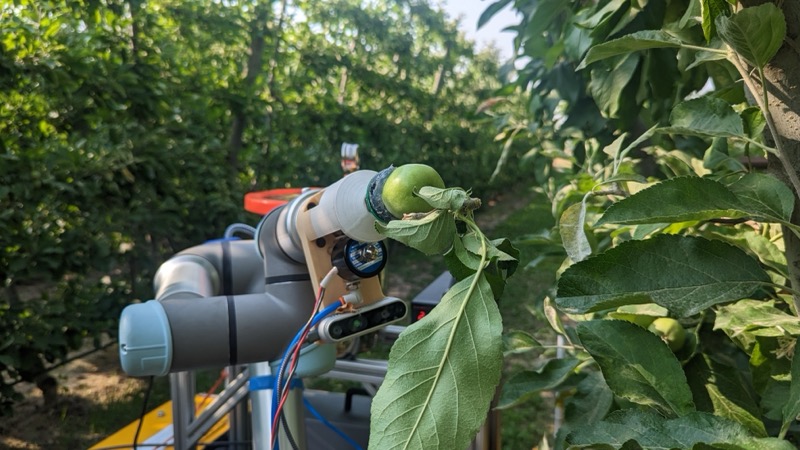
Detecting and sizing immature fruitlets, then removing excess fruit with a soft robotic manipulator so trees carry an optimal crop load.
Large language models as a new tool for agriculture
A UW-Madison Extension article covers a review led by Ranjan Sapkota, published in IEEE Transactions on Automation Science and Engineering, on multimodal LLMs in agriculture.
Cornell CALS Moonshot Award for robotic fruitlet thinning
A Moonshot Seed Grant supports development of a soft-arm robotic system for precision green fruitlet thinning in apple orchards.
Robots reaching beyond harvest (Good Fruit Grower)
Good Fruit Grower covers orchard robots being developed by Washington and Oregon university researchers for tasks beyond harvest.
Three Minute Thesis win for Ranjan Sapkota
Ranjan Sapkota won the PhD category in the WSU Biological Systems Engineering 3-Minute Thesis competition, advancing to the CAHNRS finals.
Robotics for crop pollination: Recent advances and future direction
Journal of Field Robotics, 2026
AI agents vs. agentic AI: A conceptual taxonomy, applications and challenges
Information Fusion, 126, 103599, 2026
Multi-modal LLMs in agriculture: A comprehensive review
IEEE Transactions on Automation Science and Engineering, 2025
Comparing YOLOv8 and Mask R-CNN for instance segmentation in complex orchard environments
Artificial Intelligence in Agriculture, 13, 84-99, 2024